News & Views
Agentic Commerce Won’t Eat Your Analytics (Yet)
We tried ChatGPT’s shopping agent and it recommended a mediocre weighted blanket. Agentic commerce is coming, but synthesising reviews is not the same as knowing a customer — and your analytics stack is safe for now.
Table of content
I tried ChatGPT’s Christmas shopping helper and the experience was illustrative enough to share here (though probably not in the way OpenAI intended). Setup is straightforward: describe your recipient, rate a handful of example products to calibrate preferences, and receive personalised gift recommendations.
For my wife, I explained her interests, rated ten products thoughtfully, and waited for the algorithm to work its magic.
ChatGPT’s top recommendation was a decidedly mediocre weighted blanket from bol.com.

I mean, I guess the reasoning is technically correct? But I value my life and so not in a million years will I even consider it.
The gap between ‘reasonable suggestion’ and ‘good gift’ is vast. A good gift requires knowing someone: their quirks, their running jokes, the thing they mentioned once in passing three months ago. ChatGPT can synthesise product reviews. It cannot synthesise a relationship.
And yet – the noise over the last few years has been that agents will be able to handle an entire ecommerce purchasing journey from discovery to dispatch.
This pattern will define the next few years of e-commerce, and both sides of the argument are getting louder.
The Agentic Commerce Data: Bull vs Bear
Six months ago, I’d have thought we were into a world of agentic commerce where your LLMbot of choice makes a recommendation and immediately offers to buy it for you. The data has forced me to update my position, and actually has strenghtened in both directions simultaneously.
Traffic from AI to retail sites grew 4,700 per cent year-over-year through July 2025, according to Adobe Analytics. Amazon Rufus has reached 250 million shoppers, with Amazon projecting $10 billion in incremental annualised sales. Users who engage Rufus during shopping sessions are 60 per cent more likely to complete purchases. CI&T Research found 74 per cent of consumers have used AI tools in their shopping journey during 2025. The conversion gap is closing fast: AI traffic went from 97 per cent less likely to convert in July 2024 to only 23 per cent less likely by July 2025. McKinsey projects $1 trillion in U.S. agentic commerce revenue by 2030.
The bearish data is equally compelling. A University of Hamburg study analysed 12 months of data across 973 e-commerce sites representing $20 billion in annual revenue and found that ChatGPT traffic converts ‘far worse than traditional marketing channels’. Affiliate links remain 86 per cent more likely to convert than ChatGPT referrals. ChatGPT accounts for less than 0.2 per cent of total e-commerce traffic, making it 200 times smaller than Google organic. Only 30-34 per cent of consumers say they’re comfortable with AI completing purchases autonomously, according to Contentsquare and Omnisend surveys. Amazon is actively blocking all major AI crawlers from Amazon.com, meaning nearly 40 per cent of U.S. e-commerce is invisible to ChatGPT.
Bulls look at growth rates. Bears look at absolute numbers. Bulls see adoption curves. Bears see plateau risks. Both have a point, which makes this genuinely difficult to call.
And here’s the thing. ChatGPT genuinely helped me with shopping.
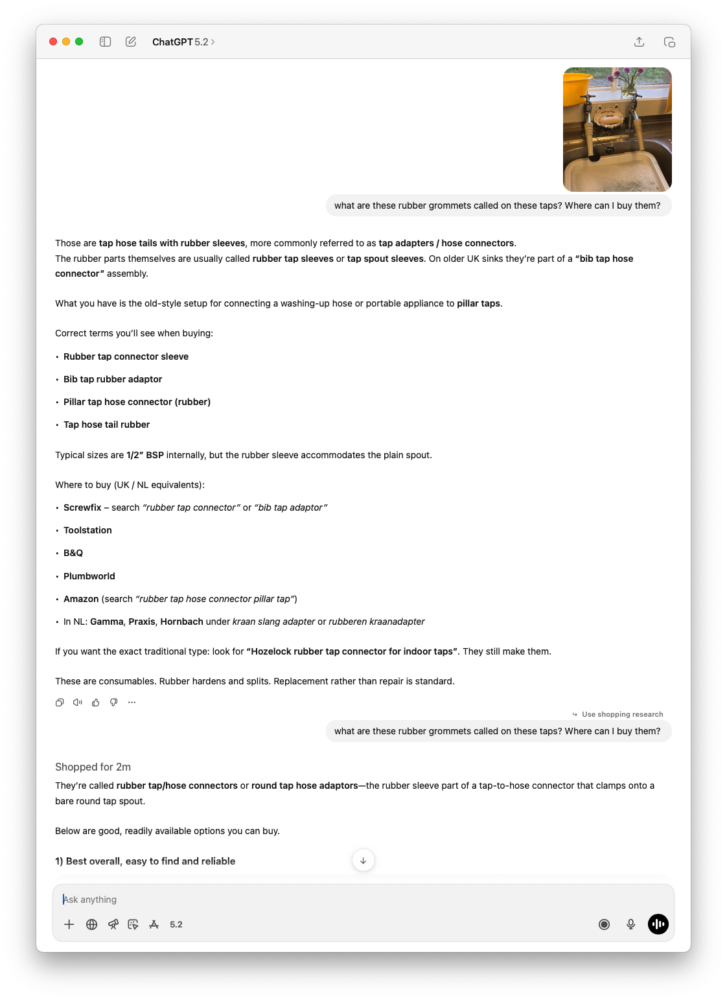
A few weeks ago, I needed to replace the rubber connectors on my kitchen tap. Old house, weird plumbing, no idea what the parts were even called. I photographed the tap and uploaded it to ChatGPT. Within seconds: ‘Those are tap hose tails with rubber sleeves, more commonly referred to as tap adapters / hose connectors.’ It gave me exact search terms: ‘rubber tap connector sleeve’, ‘bib tap rubber adaptor’, ‘pillar tap hose connector’. It told me where to buy them: Screwfix, Toolstation, B&Q in the UK; Gamma, Praxis, Hornbach in the Netherlands. It even identified the original manufacturer: ‘Look for Hozelock rubber tap connector for indoor taps. They still make them.’
Brilliant. Genuinely useful. Saved me thirty minutes of confused searching. Then I went to Screwfix and bought them myself.
The Case for AI Shopping Dominance
Snowplow’s Yali Sassoon articulates the existential threat clearly:
‘Your customers might end up buying your products on ChatGPT rather than your own website. And this might be most if not all of your customers.‘
This follows classic aggregation theory, where whoever captures intent upstream captures value downstream. Google did this to publishers. Amazon did this to brands. ChatGPT could do this to retailers if they play their cards well. The pattern is well-established, and when a platform inserts itself between demand and supply, it tends to extract increasing value from that position over time.
Consider how AI compresses the traditional shopping journey. The old path runs from awareness through consideration, comparison, decision, and finally purchase, often spanning days or weeks. AI shopping collapses this to query and purchase, with every intermediate step happening inside a single conversational interface.
My tap connector experience proves the research value: what would have taken thirty minutes of confused searching took thirty seconds. For products you can’t name, can’t describe properly, can’t even find the right search terms for, AI research is genuinely transformative. The bulls argue this naturally extends to purchase through frictionless checkout, saved preferences, and habit formation.
The infrastructure being built is real, not vapourware. For companies building AI-native data stacks, the semantic layer becomes the critical interface between AI and business logic.
The Walmart-OpenAI partnership brings real inventory, real pricing, and real fulfilment into ChatGPT. Shopify’s integration brings over one million merchants to AI storefronts. Perplexity and PayPal have connected 5,000+ merchants to in-chat checkout. OpenAI’s Agentic Commerce Protocol establishes standards for AI-to-merchant communication. Whatever you think of the adoption timeline, the technical foundations exist. And when the most sophisticated e-commerce operator on Earth bets heavily on AI shopping, as Amazon has with Rufus, they usually know something the rest of us will figure out later.
Plus – this is a good thing for the long tail of small retailers that have zero chance of ever being featured at the top of an Amazon page.
Why Agentic Commerce Has Structural Limits
Here’s Eric Seufert articulating the core problem:
‘The higher intent the product is that you want to buy, the less likely you are to give an agent that responsibility because the risk is higher… And the lower intent the thing is, the less it benefits from research, so I don’t need an agent to do that for me either.’
This creates a fundamental paradox, not an early-stage limitation. Low-value items like toothpaste and household basics are already solved by Subscribe & Save, recurring orders, and shopping lists. Nobody needs AI to ‘discover’ Colgate, and the research cost exceeds the benefit.
My tap connectors were exceptional because they were unusual: unknown terminology, obscure product category, genuine identification challenge. Most consumables aren’t like this. At the other end, high-value items like travel, luxury goods, and considered purchases carry too much risk to delegate. Personal preference is too specific, and the purchase experience IS part of the value. The weighted blanket recommendation wasn’t technically wrong; it was emotionally wrong. For gifts, for travel, for anything personal, technical adequacy isn’t enough.
The supposed sweet spot in the middle, the $50-500 category of things that benefit from some research but aren’t life-changing decisions, turns out to be thinner than it appears. Either you care enough about these purchases to research yourself and enjoy doing so, or you don’t care enough to involve AI either.
Andrew Lipsman’s analysis introduces what he calls the ‘complexity/competence conundrum’. For agentic commerce to succeed, a sequence must complete: shopper knows how to prompt AI effectively, trusts the agent with financial information, agent finds a satisfactory product, product actually works as expected, no returns needed. Each step has less than 100 per cent probability. Multiply them together and ‘the probability of a successful agentic commerce transaction is infinitesimal’. The maths is hard to argue with.
Platform economics compound the problem. Amazon generated $56 billion in advertising revenue in 2024 and will not voluntarily surrender customer relationships to third-party AI platforms. Amazon is blocking OpenAI, Google, Perplexity, and Claude crawlers from Amazon.com and actively suing Perplexity for attempting to enable purchases through its Comet browser. Nearly 40 per cent of U.S. e-commerce is invisible to ChatGPT, and the transformation thesis requires Amazon’s cooperation. They’re not cooperating.
The affiliate model creates its own trap. Sam Altman has indicated ChatGPT will charge ‘like a 2 per cent affiliate fee’ for purchases, which caps revenue potential dramatically compared to advertising. If ChatGPT generates $1 billion in shopping GMV at 2 per cent commission, that’s $20 million, versus potential billions from advertising to hundreds of millions of weekly users. The affiliate model also creates a trust problem, as recommendations optimised for commission tend to favor low cost, high conversion products according to Seufert. Temu-tier goods would dominate.
Historical precedent isn’t encouraging either. Voice commerce in 2018 promised that Alexa would buy everything; adoption stalled at basic reorders. Metaverse commerce in 2022 promised shopping in VR; it went nowhere. Livestream commerce in 2023 had industry projections predicting a $58 billion U.S. market by 2025; the actual market is a fraction of that. Each made the same error: assuming capability equals adoption.
The bear case is more likely correct, not because the technology doesn’t work (my tap connectors prove it does) but because the use cases are structurally narrower than advertised. “AI will dominate product research and discovery. AI will not dominate the actual purchase. This mirrors what we’ve observed in agentic analytics more broadly: the technology works, but only when semantic foundations are solid. The last mile remains human.
What AI Shopping Data Actually Shows
Look past the headline numbers and a pattern emerges. On shopper intent, the signals are bullish: 74 per cent have used AI in their shopping journey, traffic is growing exponentially, Rufus engagement correlates with conversion, and consumers are clearly interested in AI-assisted shopping. On actual behaviour, the signals are bearish: only 30-34 per cent are comfortable with autonomous purchase, ChatGPT traffic remains below 0.2 per cent of e-commerce in absolute terms, and conversion stays 23 per cent worse than traditional channels even after narrowing significantly. Using AI does not equal buying through AI.
The bullish case assumes early adoption predicts mature behaviour, that early users figure it out, demonstrate value, and adoption spreads. The bearish case argues adoption plateaus once novelty fades and genuine use cases are exhausted, and that the people using AI shopping now are experimenters while mass adoption requires mass utility. I lean bearish because the use case narrowness is structural rather than early-stage, because platform economics actively resist agentic intermediation, because consumer preferences for high-value purchases are sticky, and because Amazon isn’t playing along.
If this view is correct, AI becomes a powerful search and discovery layer that sits above traditional e-commerce. Brands need visibility in AI responses. But the actual transaction, and the analytics infrastructure around it, largely stays intact. This is manageable. This is not an existential threat.
What Agentic Commerce Means for E-commerce Analytics
If you’re running e-commerce analytics, you’ve probably been asked what your AI commerce strategy should be. The honest answer depends on which scenario materialises, but some investments make sense regardless of outcome.
You probably have no idea how often your brand appears in ChatGPT, Claude, or Perplexity responses. You don’t know whether you’re in the ‘consideration set’ when someone asks ‘What’s the best [your category]?’
This measurement gap didn’t exist two years ago, but emerging tools like Amplitude’s AI Visibility, Profound, and Evertune now offer monitoring capabilities. Even manual monitoring helps: run queries for your category weekly, track brand mentions, note competitive positioning. The KPIs to establish include brand mention frequency in AI responses, consideration set inclusion rate, competitive share of voice in AI recommendations, and source citation quality.
This matters regardless of which scenario wins. If agentic commerce takes off, AI visibility determines who gets recommended. If agentic commerce stalls, AI still dominates the research phase and influences where people then go to buy. Brand perception in AI responses shifts within three to four months with focused content strategy, so structured data, schema markup, and allowing AI crawlers in robots.txt all contribute. Early movers get compounding advantages.
Adobe’s data shows AI traffic converts 23 per cent worse than traditional channels but also shows 27 per cent lower bounce rates and 32 per cent more time on site. These aren’t bad visitors; they’re different visitors. AI-referred traffic arrives warmed up, having done research and formed intent, but they’ve also comparison-shopped in the AI conversation already. They may be more price-sensitive and more decisive, but also more specific about what they want.
Segment this traffic in your analytics using utm_source parameters or referrer patterns, build separate conversion funnels, and test different landing experiences. We’re seeing AI traffic respond better to specific product pages and worse to category pages, because they’ve already decided roughly what they want and are looking for validation and purchase rather than discovery. Optimising for this traffic while it’s small gives you learnings before volume matters.
The asymmetric threat worth planning for is relationship collapse rather than attribution collapse. If purchases increasingly happen in AI interfaces, you potentially lose email capture at checkout, browse patterns before purchase, purchase context, and post-purchase engagement touchpoints. The AI handles discovery and transaction; you fulfil the order but never build a direct customer relationship. What survives regardless includes loyalty programme members, app users, email subscribers acquired through other channels, direct site visitors, and anyone you have a first-party relationship with already. Create explicit value exchanges for first-party data collection that go beyond ‘sign up for our newsletter’: early access, exclusive products, personalisation, loyalty benefits that matter. Invest in core data infrastructure that unifies touchpoints you control, and accept that consideration-phase visibility may become partially opaque. Compensate by owning the post-purchase relationship more deliberately.
This brings me to the point that matters most regardless of how agentic commerce plays out: solid data foundations don’t become less important as discovery channels fragment. They become more important. We’ve written extensively about why agentic marketing analytics fails without strong semantics — the same principle applies to commerce.
If your current analytics stack can’t segment by traffic source, can’t track customer lifetime value properly, can’t connect marketing spend to revenue, fix that first. Our guide on scaling BI for growing companies covers the specific bottlenecks to address. AI commerce scenarios are a distraction if your fundamentals aren’t in place. The companies that will navigate uncertainty best are those with infrastructure flexible enough to measure whatever future arrives.
The Future of AI Shopping: An Honest Assessment
I’ve spent several thousand words making confident arguments, but the honest truth is that nobody knows how this plays out. McKinsey might be right. Seufert might be right. Both might be partially right in different categories. My betting odds are 70 per cent that AI dominates research while purchase stays largely traditional (the weighted blanket scenario, where AI can suggest but humans decide), 20 per cent that AI captures meaningful purchase share in specific narrow categories of low-risk, low-consideration, highly standardised products, and 10 per cent that full transformation happens and AI becomes the primary shopping interface.
What I’m actually doing is monitoring AI visibility for clients, building measurement infrastructure that works across scenarios, not panicking about attribution collapse, and staying genuinely uncertain while building capabilities that work either way. The best analytics teams aren’t those who predict the future correctly. They’re those who build systems capable of measuring whatever future actually arrives. Flexibility matters more than conviction right now.
ChatGPT won’t buy Monique’s Christmas present this year, or next year, probably ever. A weighted blanket from bol.com is not what she’s getting. But ChatGPT did help me find obscure rubber tap connectors in about thirty seconds, identifying the product, giving me the terminology, pointing me to retailers. That’s genuinely useful. That’s the real AI shopping value proposition. Research, discovery, identification of the unknown: brilliant. Emotional judgment, personal taste, purchase authority: still mine. And that’s probably how it should stay.