News & Views
How to Turn Your Data Foundations Problem into an AI Readiness Conversation
Leadership will not fund data foundations in the abstract — they fund them after seeing the cost of not doing it, traced through a report they actually rely on. A good briefing walks one number from source to decision and names the damage in their language.
Table of content
Getting your data house in order requires leadership buy-in. There is no version of this where the data team fixes the foundations on its own — the work crosses too many systems and touches too many definitions. It needs strategic decisions that sit squarely at CEO/CFO/CTO level, and it needs the funding to go with them.
If you’re the most senior data person at your company, you’ve probably already tried. You raised the problem, leadership listened politely, and then the next AI demo came along and your pipeline priorities went back to the bottom of the stack. That is not a communication failure on your part. It is structural: nobody has shown your leadership what broken data actually costs them. That is the job, and the rest of this piece is the playbook.
The reframe that’s working — call it AI prep
Ben Rogojan put it cleanly in his 2026 predictions: instead of pitching foundations work as foundations-for-the-sake-of-it, you rebrand it as AI prep. ‘We can’t trust an AI agent on this data’ gets a hearing where ‘we need to fix our pipelines’ doesn’t.
Use it. Leadership is already spending on AI, and redirecting some of that spend is easier than creating a new line item. The phrase that has actually worked in client conversations: ‘We don’t have a data problem. We have an AI-readiness problem.’ – that sentence really does wonders and opens doors.
But it’s not sufficient. What is missing is not a better hook — it’s an actual business case. And a business case means a brief.
Understand why there is resistance – that’s step zero
If you’ve raised this before and been told it can wait, you already know it isn’t about the strength of your technical argumentation of why it’s necessary. Instead, it’s political and financial — and that’s a different problem with a different fix. The frustrating part is that leadership isn’t being wilfully blind. Understanding why they respond the way they do is actually the first thing that puts you ahead of the conversation.
It is likely that your CEO/COO/CFO/CMO has never been in the room when a metric was defined. They have inherited every number on every dashboard. They cannot see what is broken because they have no authorship relationship to what is right.
This is structural, not a character flaw. By the time someone is CMO or CFO at a scale-up, the metrics on their Monday dashboard were defined by people who have since left. The number is just there. It either matches their gut or it doesn’t.
That is why ‘we need to fix the foundations’ sounds like maintenance to them. They are being asked to fund hygiene on infrastructure they didn’t build and don’t feel responsible for. The gap isn’t belief. It is co-authorship.
We landed on a version of this at our London dinner with Omni in March, when fifteen data leaders sat down to talk about why nobody trusts AI analytics yet. The conclusion was that the context layer — the why behind every metric — is institutional knowledge. Only the institution can populate it. The data team can build the structure that captures it. They cannot author it for leadership.
Which is why the persuasion problem is, structurally, a briefing problem. The brief is what brings leadership into authorship for the first time.
Build a factual brief to support your arguments
Start with a one-pager. One number your leadership already depends on, one paragraph on where it comes from, one paragraph on where it breaks, one line on what that costs them. A CFO who has dismissed this as a maintenance problem won’t read six pages cold — but they will read one, if the number on it is one they care about. The goal of the one-pager isn’t to close the argument. It is to open the questions. And once they’re asking questions, you have the room: that is when the full briefing comes in.
The full brief is four to six pages, in prose, that leadership reads before any real conversation happens. Not slides. Not a workshop deck. A document that walks them through that same number, and shows them exactly how it is held together. (Think Amazon-style memos, but better written.)
It should answer five questions, in order:
1. What decision is currently at stake. Not foundations in the abstract. A live decision the executive team is wrestling with: the CAC-by-channel number behind next quarter’s marketing budget, the ARR forecast that has been off three quarters in a row, the retention cohort the board keeps asking about.
2. What number drives that decision today. State it. Quote the version in the most recent board pack or planning doc. If three people in the room reach for three different definitions — and this happens more than anyone admits, particularly for terms like ‘number of leads’ or ‘LTV’ — that fact goes in the brief.
3. Where that number comes from. Source systems, joins, definitions of every term inside the number, including the ones nobody thinks need defining. What counts as a customer. What counts as active. Which date field gets used and what it resets on. Who owns each link in the chain.
4. Where it falls apart. The specific places this number breaks or doesn’t reconcile: the marketing-versus-finance definition mismatch, the date field that resets when a subscription pauses, the migration that quietly changed the meaning of a status column eighteen months ago and never got documented.
5. What it costs when it falls apart. Translated into leadership’s language, not yours. Wrong board pack. Misallocated budget. An AI assistant reporting fiction to a stakeholder who will act on it before anyone checks. A two per cent error rate in your CAC figure doesn’t look like much until you map it to campaign spend — at which point the entire channel mix decision becomes unreliable.
Each section should be short, and each one is a forcing function. You cannot answer the fourth question without understanding the pipeline; you cannot answer the fifth without translating the cost into something the CFO will feel in their stomach.
This is the business logic discovery step in our engagements. As we wrote in our piece on the semantic layer, step one is always to align on the right definitions before we commit a single line of model code. The brief is the artefact that captures that alignment and makes it portable — readable on a train, forwardable to the CFO, actionable in the next planning cycle.
What changes once leadership has read it: the room is no longer about whether foundations matter. It is about which decision to fix first. You stop being the petitioner. You become the facilitator of a conversation the leadership team is now having with itself.
What to say when they push back
You will hear objections. Here are the three most common ones and how to address them.
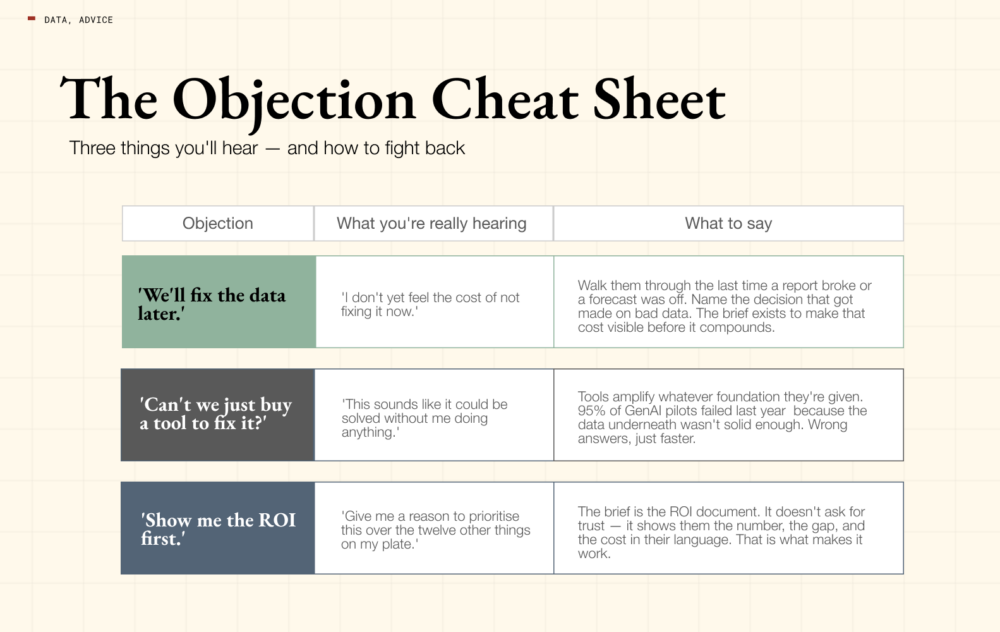
What happens when you skip the brief
The chain runs: cultural debt becomes technical debt becomes confidently wrong analytics. The team that didn’t have time to write the brief is the team whose AI assistant reports a misleading revenue figure to the board next quarter, in fluent English, with no flag that anything is off. The cost isn’t a delayed project. It is wrong decisions, compounding in places nobody is looking, until someone at board level acts on a number that was never solid to begin with.
The cultural work is half the engineering
It has always been half the engineering. The brief is where the cultural work becomes legible enough to act on. It is also where a data person stops being a translator between systems and starts being a translator between people.
Writing one is harder than it looks. It took us sixty engagements to get good at it, and we still rewrite the structure most quarters. The five-question shape above is the version that has held up best.
If you want help writing yours — the one-pager, the business case, the conversation — that is exactly what we do. We’ve run this process across sixty engagements with European scale-ups, and it starts with one number and ends with a funded roadmap. Get in touch.