Success stories

Data Foundations for €43M Post-Series B Reporting

Data Foundations

Industry

AI-Powered SaaS / App

Company size

50-80 employees

Established

2019

Value

€43M Series B at €500M

Location

Paris, France

How Photoroom built data foundations that enabled €43M post-series B investor reporting and then hired a CFO and Head of Data who hit the ground running.
Who is Photoroom?

Photoroom is an AI-powered creative partner built for commerce serving 20M+ monthly active users globally, processing over 5 billion images annually. With a unique B2B/B2C hybrid model spanning freemium, paid, and teams licences, Photoroom has built one of the fastest-growing photo editing apps while maintaining exceptional capital efficiency.

Founded in 2019 and headquartered in Paris, Photoroom raised their Series B at a €500M valuation in 2024, backed by Balderton Capital, Meta Platforms, and Y Combinator. The company has maintained their competitive edge through relentless focus on 1M target ARR-per-employee.

Why Data Mattered

For a hyper-growth app company navigating complex monetisation across consumer and business segments, data is the foundation of every strategic decision. Photoroom needed to:

  • Answer investor questions with confidence after their Series B fundraising
  • Optimise pricing and conversion across freemium, paid, and teams licence tiers
  • Make data-driven product decisions on which features drive retention and revenue
  • Understand their SMB, API self serve, enterprise revenue split to inform go-to-market strategy
  • Attract senior data and finance leaders who could build on solid foundations rather than start from scratch

Without accurate, consolidated revenue reporting, Photoroom was flying blind exactly when precision mattered most.

The Data Foundation Gap

“While raising our Series B, we didn’t have anywhere where we had the revenue per quarter, per product, nothing. It took going into multiple tools for little insight…

— Charlotte, Photoroom’s Senior Product Data Analyst

Photoroom’s Series B fundraising exposed a critical gap: zero visibility into revenue by quarter, product, or customer segment. This wasn’t just an inconvenience. It threatened their ability to deliver on investor promises and posed a challenge to attracting top executives.

Specific pain points:

  • Manual data pulls from 6+ disconnected sources (Stripe, RevenueCat, Amplitude, Braze…)
  • No centralised data warehouse or reporting infrastructure
  • Couldn’t answer basic investor questions about revenue trends or product performance
  • No ability to analyse customer behaviour or optimise conversion funnels
  • No CFO or Head of Data – just Charlotte overseeing both product analytics and revenue reporting

The company had tried to engage Tasman once before, but the business case was not strong enough just yet. What changed? Charlotte joined as a senior product data analyst and made the business case that delivering on Photoroom’s Series B promises was impossible without solving their data problem first.

Given Photoroom’s strict focus on ARR-per-employee and time urgency, they couldn’t justify a 6-12 month hiring process or the budget for a full data team.

The tipping point: Photoroom needed reliable investor-ready reporting immediately — not in six months.

The Solution: Data Foundations

Phase 1: Foundation & Revenue Reporting

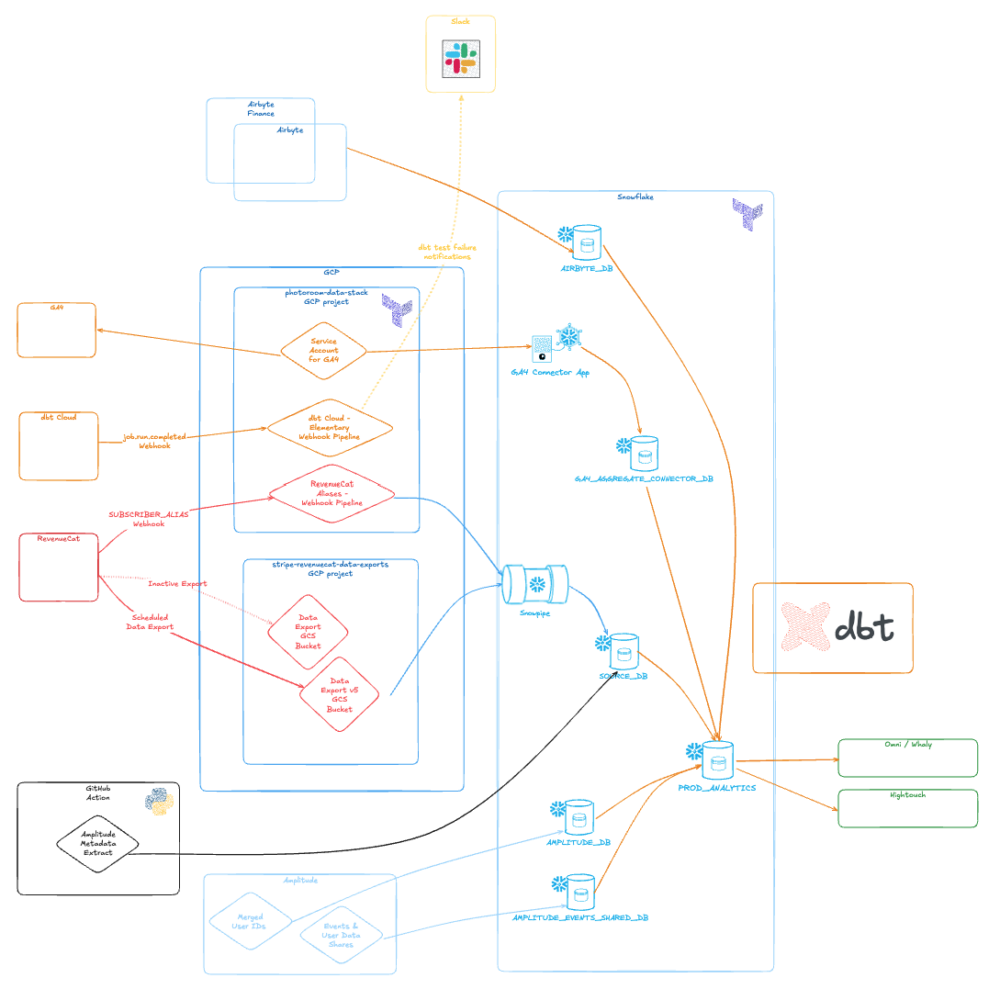
  • Snowflake data warehouse with 6+ source integrations (RevenueCat, Stripe, App Store, Google Play, Amplitude, Braze)
  • Complex revenue logic handling Photoroom’s multi-tier SMB, API self serve, and enterprise model, including edge cases and subscription states
  • Automated dashboards (Whaly, later Omni) with quarterly revenue views by product, geography, and segment
  • Custom data pipelines in GCP and Snowpipe integration for RevenueCat

Tasman delivered a complete subscription revenue reporting system in 12 weeks. Photoroom leadership could finally answer investor questions with confidence rather than scrambling through spreadsheets.

Phase 2: Minimal Reactive Maintenance

After the initial build, Photoroom engaged Tasman for low-velocity maintenance. This phase was, to put it politely, not our finest hour. We discovered what should have been obvious: small maintenance retainers don’t work when requirements keep evolving. Photoroom needed ongoing development capacity, not just the occasional bug fix. Lesson learnt.

Phase 3: Scaling the Platform

  • 125-metric automated investor reporting system (delivered in 6 weeks)
  • The most complex revenue reporting system Tasman had built, handling many edge case with full testing
  • Product analytics infrastructure enabling self-service analysis for product and growth teams
  • Secure financial environment with CI/CD pipeline and custom data ingest pipelines
  • Comprehensive documentation and knowledge transfer preparing for internal ownership

Tasman operated as Photoroom’s interim data team, across 4 quarters. The partnership continued until Photoroom hired Juliette as Head of Data—exactly as planned.

The Stack

  • Airbyte for data integration
  • Custom RevenueCat ingestion via Snowpipe + webhooks
  • Snowflake data warehouse with data masking for sensitive financial data
  • Hightouch for reverse ETL
  • Full CI/CD pipeline with Terraform infrastructure-as-code
  • dbt with packages, data dictionary, and Elementary observability
  • Comprehensive financial reporting models
  • Whaly (later migrated to Omni) for business intelligence
  • Slack alerting for data quality monitoring

The Impact: Driving Decisions

“We went from not being able to answer business questions to people in the business teams directly asking their questions in natural language and getting the answer in under 1 minute”

— Juliette, Photoroom’s Head of Data

Post-Series B Success: Investor Confidence Through Data

  • Real-time revenue visibility across all products and geographies enabled confident investor reporting
  • Accurate forecasting capabilities demonstrated operational maturity
  • Infrastructure delivered in 16 weeks—fast enough to support investor reporting urgency without adding bottlenecks to their internal team

For the CFO: Day-One Financial Intelligence

Post-Series B, Photoroom hired their first CFO. Unlike typical CFO onboarding where the first 6 months are spent building basic financial reporting, Photoroom’s CFO walked into:

  • 18+ months of clean, accurate historical revenue data across all segments
  • Automated revenue reporting by product, geography, and customer type
  • Clear visibility into subscription metrics including MRR, churn, and cohort performance
  • Foundation for board reporting and strategic planning

For the Head of Data: A Platform Ready to Scale

When Photoroom hired Juliette as Head of Data, she inherited a production-ready data platform instead of a greenfield projects:

  • Fully functional financial models already in production with CI/CD and monitoring
  • Infrastructure enabling immediate focus on new sources and business impact
  • Proven architectural patterns and expert advisors for decisions like BI tool selection
  • Monitoring systems for engineering costs already in place

For the Product Team: Self-Service Analytics

  • Charlotte finally gained insights about revenue retention per segment
  • Product team could make data-driven decisions on feature development
  • Clear understanding of conversion funnels across SMB, API self serve, and enterprise segments enabled targeted optimization
  • Confidence in data quality enabled faster experimentation and iteration

Built to Hand Over

Photoroom’s success means we delivered on our pro-empowerment, no lock-in philosophy.

Fixed-scope sprints provided predictable costs and rapid value delivery without open-ended retainers. Each quarter, Photoroom chose whether to continue — true partnership, not dependency.

Knowledge transfer as default meant Charlotte could manage the platform independently, not wait for consultant availability. When Juliette joined, she had full ownership from day one. Our goal is to make ourselves unnecessary, which is either terrible business strategy or rather good ethics. We’ve chosen to believe the latter.

Well-organised meetings and project management meant zero wasted time or miscommunication across the engagement.

Specialist expertise across analytics, data engineering, and delivery ensured any technical challenge could be solved without piecing together multiple vendors. Photoroom got a full data team’s capabilities without the hiring overhead or the office politics.

Most importantly, Tasman’s goal was to make themselves redundant — building a foundation that enabled Photoroom to hire and empower their own data and finance leaders.

Fast Forward

Eighteen months after initial delivery, 100% of Tasman’s infrastructure remains in production — including dbt jobs, observability systems, alerts, and Terraform configurations. This durability demonstrates the quality of the foundational architecture.

With their data infrastructure in place and leadership team expanded, Photoroom continues to scale their data capabilities under Juliette’s direction. The platform Tasman built has evolved to support:

  • Expanded product analytics as Photoroom launches new features and experiments with pricing
  • More sophisticated revenue forecasting and scenario planning for the CFO
  • Deeper customer segmentation enabling targeted growth strategies across SMB, API self serve, and enterprise
  • Data team growth as Photoroom scales their analytics capabilities

Your Turn?

For companies preparing for fundraising, navigating complex business models, or evaluating when to hire senior data and finance leaders, Photoroom’s journey offers a clear playbook. Invest in foundations early, partner for speed, and build towards independence. The right infrastructure doesn’t just solve today’s problems — it enables tomorrow’s leaders.

Is your company preparing for a funding round without clear revenue visibility? Or struggling to attract senior data leadership because infrastructure isn’t in place?

Get in touch to learn how we can build investor-ready data foundations in weeks, not quarters.

Contact form